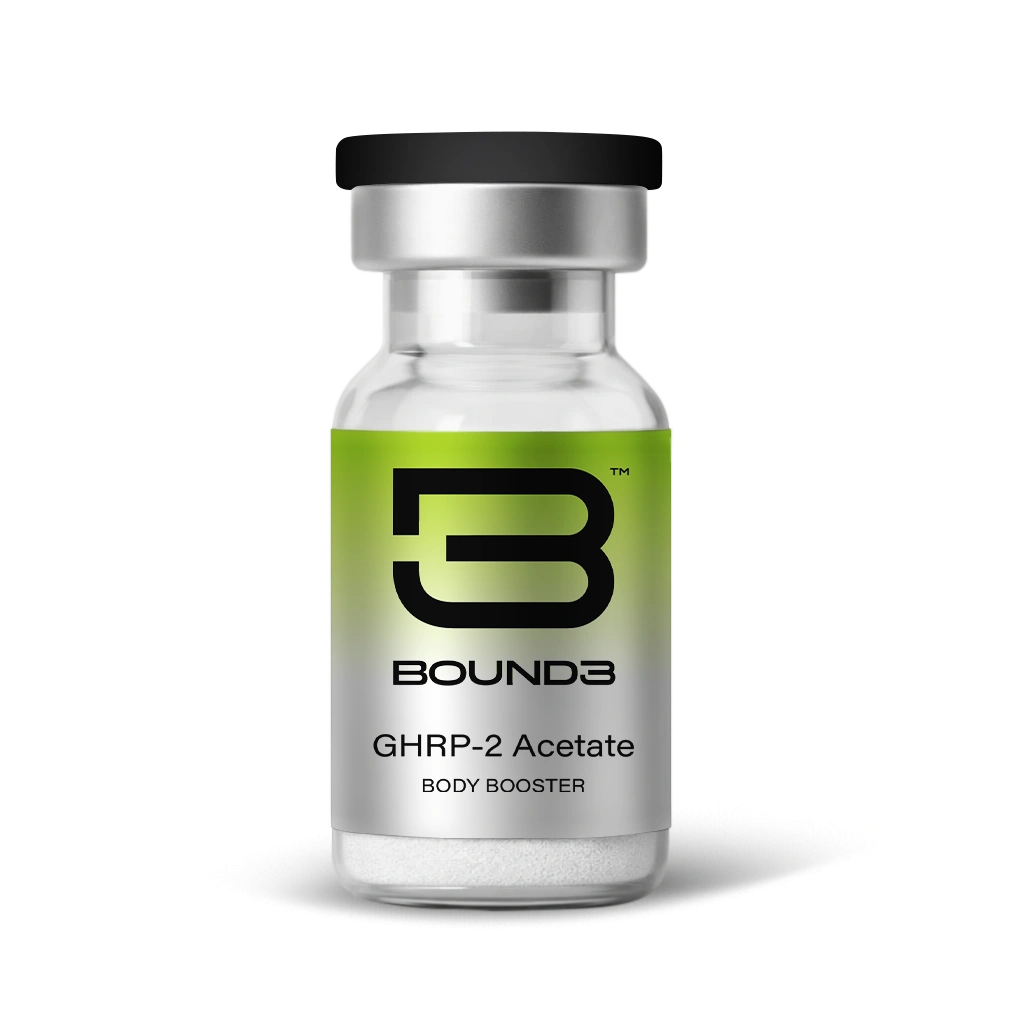
GHRP-2 Acetate
In simple terms, GHRP-2 is a peptide used in research to study how the body: releases growth hormone, regulates hunger, controls hormonal responses at the level of the brain and pituitary. It is not just related to muscle growth; research shows it also affects appetite, energy balance, and stress hormones.
GHRP-2 Acetate
Product Details
| Parameter | Specification |
| Purity | ≥ 99% (HPLC, third-party tested) |
| Form | Lyophilized peptide powder |
| Content | 10 mg GHRP-2 per vial |
| Packaging | Glass vial with sterile closure |
| Storage Conditions | Store lyophilized at 2–8 °C (desiccated, protect from light) |
| Molecular Formula | C45H55N9O6 |
| Molecular Weight | ≈ 818.0 g·mol⁻¹ |
| Amino Acid Sequence | H-D-Ala-D-2-Nal-Ala-Trp-D-Phe-Lys-NH2 |
| CAS Number | 158861-67-7 |
| Solubility | Bacteriostatic water |
Overview
GHRP-2 Acetate (Growth Hormone Releasing Peptide-2) is a synthetic peptide belonging to the class of growth hormone secretagogues (GHSs). Pharmacologically, it acts as an agonist of the ghrelin receptor, also known as the growth hormone secretagogue receptor type 1a (GHS-R1a). Through this mechanism, it mimics certain biological effects of endogenous ghrelin and stimulates the secretion of growth hormone (GH). In the scientific literature, GHRP-2 is consistently described as a potent inducer of pulsatile GH release, with its effects mediated via both central (hypothalamic) and peripheral (pituitary) mechanisms.
What It Is and How It Works
Upon binding to the GHS-R1a receptor, GHRP-2 activates the hypothalamic–pituitary axis, leading to increased secretion of growth hormone. Importantly, available data indicate that its activity is not limited to indirect hypothalamic stimulation; GHRP-2 can also exert direct GH-releasing effects on pituitary somatotroph cells. This has been demonstrated in experimental models involving subjects with non-functional GHRH receptors, where GHRP-2 was still capable of inducing GH release. These findings suggest that GHRP-2 operates through a partially GHRH-independent signaling pathway, distinguishing it from classical GHRH analogs. Instead, it represents a parallel and complementary regulatory pathway within the somatotropic axis. From a mechanistic standpoint, GHRP-2 should therefore be understood not as “growth hormone” itself, but as a growth hormone secretagogue—a compound that enhances endogenous GH release. Additionally, activation of the ghrelin receptor implicates GHRP-2 in the regulation of appetite and energy homeostasis, as GHS-R1a is widely expressed in pathways controlling feeding behavior.
Effects Confirmed by Research
The most well-established effect of GHRP-2 is its robust stimulation of growth hormone secretion. In human studies, GHRP-2 has consistently demonstrated significant increases in circulating GH levels and, in some cases, has produced a stronger somatotropic response than GHRH alone. Notably, GH responses to GHRP-2 have also been observed in individuals with isolated GH deficiency caused by mutations in the GHRH receptor, supporting the hypothesis of a GHRH-independent component of action. However, GHRP-2 is not endocrinologically selective for GH alone. Clinical studies have shown that it also increases levels of: Prolactin (PRL), Adrenocorticotropic hormone (ACTH), Cortisol. This broader endocrine activation indicates a significant role in hypothalamic–pituitary–adrenal (HPA) axis modulation. Consequently, GHRP-2 has been utilized in certain clinical settings as a dynamic stimulation test, particularly in the evaluation of GH deficiency and secondary adrenal insufficiency. More recent research suggests that simultaneous monitoring of ACTH during GHRP-2 testing may improve diagnostic sensitivity.
Appetite and Metabolic Effects
Another well-documented research domain involves appetite regulation and food intake. As a ghrelin receptor agonist, GHRP-2 exhibits orexigenic properties. Human studies have demonstrated that acute administration of GHRP-2 leads to a dose-dependent increase in ad libitum food intake, observed in both lean and obese subjects. Additionally, research suggests that GHRP-2 may influence: upper gastrointestinal motility, postprandial contractile activity. These findings align with the broader physiological role of ghrelin in coordinating feeding behavior and digestive function. In preclinical models, ghrelin receptor agonists—including GHRP-2—have been associated with positive energy balance and increased adiposity, emphasizing that their biological profile extends beyond GH stimulation to include metabolic and orexigenic effects. This has made GHRP-2 relevant in experimental research related to: cachexia, anorexia, unintended weight loss.
Scientific Positioning
From a scientific perspective, GHRP-2 Acetate is best described as a potent ghrelin-mimetic GH secretagogue with a well-characterized effect on the hypothalamic–pituitary axis. Its defining features include: Strong stimulation of GH secretion, Orexigenic (appetite-stimulating) activity, Activation of additional endocrine pathways (ACTH, cortisol, prolactin). Rather than being viewed narrowly as a “GH peptide,” GHRP-2 should be understood as a multi-axis neuroendocrine modulator, influencing interconnected hormonal and metabolic systems.
References
Laferrère, B., et al. (2005). Growth Hormone Releasing Peptide-2 (GHRP-2), Like Ghrelin, Increases Food Intake in Healthy Men. Journal of Clinical Endocrinology & Metabolism, 90(2), 611–614. Gondo, R. G., et al. (2001). Growth Hormone-Releasing Peptide-2 Stimulates GH Secretion in GH-Deficient Patients with Mutated GHRH Receptor. Journal of Clinical Endocrinology & Metabolism, 86(7), 3279–3283. Peroni, C. N., et al. (2012). Growth Hormone Response to Growth Hormone-Releasing Peptide-2 in Patients with Inactive Growth Hormone-Releasing Hormone Receptor. Arquivos Brasileiros de Endocrinologia & Metabologia. Arvat, E., et al. (1997). Effects of GHRP-2 and Hexarelin on Somatotroph and Corticotroph Function. Peptides. Hayakawa, T., et al. (2018). Evaluation of the Hypothalamic–Pituitary–Adrenal Axis by GHRP-2 Test. Endocrine Journal. Suzuki, S., et al. (2022). Clinical Usefulness of the GHRP-2 Test for Secondary Adrenal Insufficiency. Endocrine Journal. Kimura, T., et al. (2010). Evidence for ACTH-Releasing Activity of GHRP-2. Endocrine Journal. Laferrère, B., et al. (2006). Ghrelin Agonist GHRP-2 Increases Food Intake in Obese Subjects. Obesity. Kudoh, K., et al. (2009). Effects of GHRP-2 on Gastrointestinal Motility and Food Intake. Tschöp, M., et al. (2000). Ghrelin Induces Adiposity in Rodents via Positive Energy Balance. Nature.