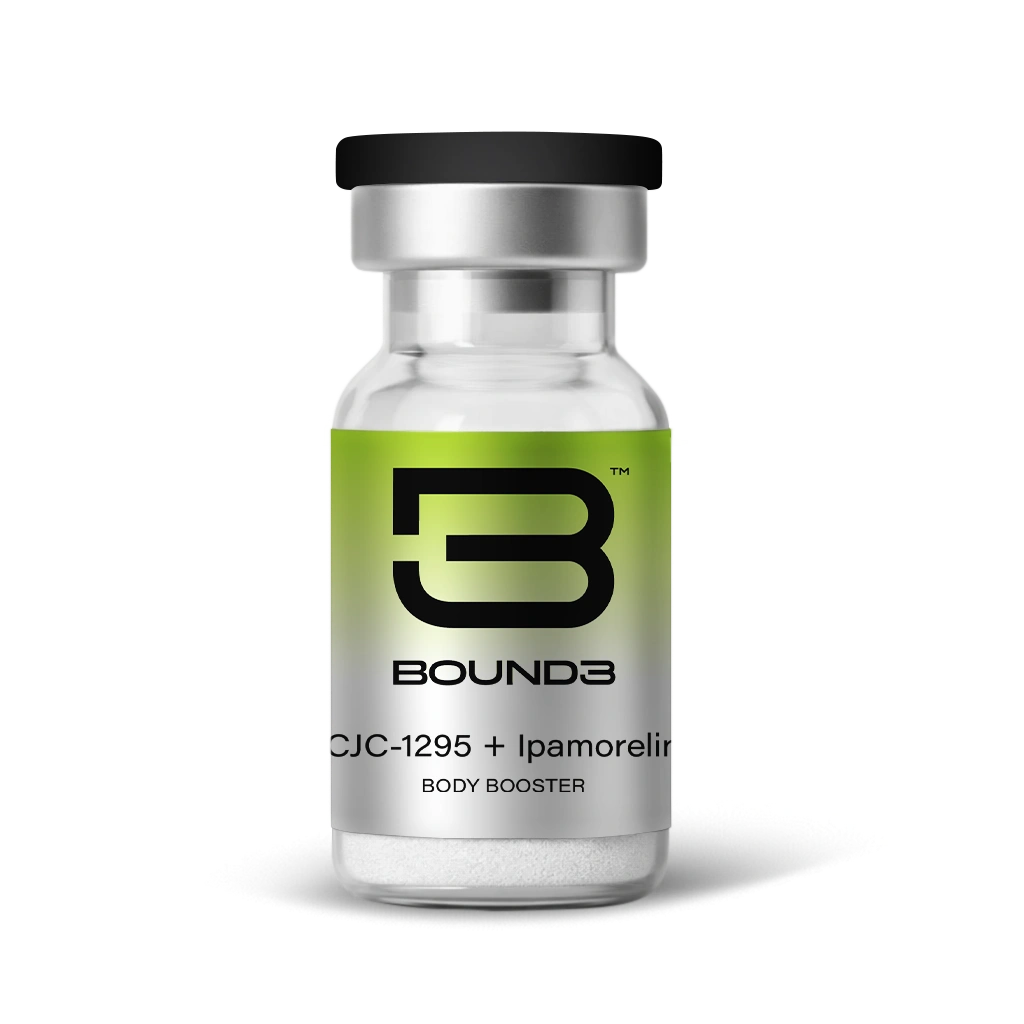
CJC-1295 without DAC + Ipamorelin
Put simply, this peptide combination is used in research to study how the body’s own growth hormone signaling can be stimulated through two different control switches at once. One peptide acts more like a signal to the pituitary to release GH, while the other acts more like a ghrelin-style trigger that helps strengthen that response.
Product Details
| Parameter | Specification |
| Purity | High-purity research grade |
| Form | Lyophilized peptide powder |
| Content | 5 mg Ipamorelin & 5 mg CJC-1295 (no DAC) per vial |
| Packaging | Glass vial with sterile closure |
| Storage Conditions | Store lyophilized at 2–8 °C (desiccated, protect from light) |
| Molecular Formula | Mixture |
| Molecular Weight | Mixture |
| Amino Acid Sequences | Ipamorelin: Aib-His-D-2-Nal-D-Phe-Lys-NH2 CJC-1295 (no DAC): Tyr-D-Ala-Asp-Ala-Ile-Phe-Thr-Gln-Ser-Tyr-Arg-Lys-Val-Leu-Ala-Gln-Leu-Ser-Ala-Arg-Lys-Leu-Leu-Gln-Asp-Ile-Leu-Ser-Arg-NH2 |
| CAS Numbers | 170851-70-4 (Ipamorelin); 863288-34-0 (CJC-1295 no DAC) |
| Solubility | Bacteriostatic water |
Overview
CJC-1295 without DAC + Ipamorelin is best understood as a two-pathway growth hormone secretagogue research combination. The first component, CJC-1295 without DAC, is commonly used to refer to a short-acting GHRH analog / modified GRF(1-29)-type peptide that stimulates the growth hormone–releasing hormone receptor (GHRH-R). The second component, Ipamorelin, is a selective growth hormone secretagogue receptor 1a (GHS-R1a) agonist, meaning it acts through the ghrelin receptor pathway to stimulate endogenous GH release. Mechanistically, the pairing is intended to engage both major physiologic inputs that regulate pulsatile GH secretion: the GHRH pathway and the ghrelin/GHS pathway. Evidence supporting each pathway separately is strong, but direct peer-reviewed human data on the exact combination are limited; most published literature evaluates CJC-1295 with DAC and Ipamorelin alone, or discusses the broader physiology of GHRH-plus-GHS co-stimulation (OUP Academic).
What it is and how it works
From a physiological perspective, GH secretion is regulated by at least three core signals: GHRH, somatostatin, and ghrelin/GHS-R1a signaling. A GHRH analog such as CJC-1295 without DAC is designed to mimic endogenous GHRH and stimulate pituitary somatotrophs via the GHRH receptor, thereby increasing GH pulse generation. By contrast, Ipamorelin activates GHS-R1a, the same receptor family involved in ghrelin signaling, and thereby promotes GH release through a distinct but complementary mechanism. Reviews of GH secretagogue physiology consistently emphasize that the GHRH and GHS systems are separate, interacting regulatory axes, which is the main scientific rationale for combining these agents in research settings (PMC). For CJC-1295, the strongest clinical literature is on the DAC-containing version, which was specifically developed as a long-acting GHRH analog. In placebo-controlled studies, CJC-1295 produced prolonged, dose-dependent increases in GH and IGF-1 in healthy adults, with effects lasting days rather than hours because of albumin binding and an extended half-life. This is important scientifically because it confirms that pharmacologic enhancement of endogenous GH signaling through a GHRH analog is feasible and biologically robust in humans. However, that same paper is not evidence for the without-DAC version specifically, which is shorter acting and generally positioned in research use as more “pulse-oriented” than the long-acting DAC form (OUP Academic). Ipamorelin, on the other hand, is notable because it was characterized as the first selective growth hormone secretagogue in its class. In preclinical pharmacology, it stimulated GH release with potency comparable to older GHRPs, but with markedly greater selectivity and substantially less stimulation of non-GH hormones than less selective secretagogues. That selectivity is one of the main reasons Ipamorelin is discussed differently from peptides such as GHRP-2 or GHRP-6, which are more likely to influence prolactin, ACTH, cortisol, and appetite-related pathways to a greater extent (PubMed).
Effects supported by research
The best-supported effect for this combination concept is enhanced endogenous GH-axis stimulation through dual receptor engagement. The scientific logic is that a GHRH analog increases pituitary responsiveness and GH pulse initiation, while a GHS-R1a agonist such as Ipamorelin enhances pulse amplitude through the ghrelin-secretagogue arm. Endocrine reviews and receptor-level analyses support the idea that these are complementary rather than redundant mechanisms. That said, the literature supports the mechanistic plausibility of dual-pathway stimulation much more strongly than it supports claims about any exact commercial dose pairing (PMC). For the GHRH analog component, human evidence shows that CJC-1295 can significantly raise GH and IGF-1 concentrations. In the pivotal clinical study, single and multiple doses of CJC-1295 were associated with sustained increases in both GH and IGF-1, demonstrating that the molecule can meaningfully activate the GH/IGF-1 axis in healthy adults. Serum proteomic follow-up work also documented downstream biological changes consistent with GH/IGF-1 activation after CJC-1295 exposure. Again, these findings apply most directly to CJC-1295 with DAC, but they remain highly relevant to the broader scientific profile of CJC-class GHRH analogs (OUP Academic). For the Ipamorelin component, the key confirmed effect is selective GH release. In the foundational pharmacology paper, Ipamorelin stimulated GH secretion in rat pituitary cells and in vivo animal models with potency similar to GHRP-6, while retaining a more selective hormonal profile. That selectivity matters in research, because it suggests Ipamorelin may allow investigators to study GHS-R1a-mediated GH signaling with less confounding activation of other endocrine axes than is seen with older GHRPs (PubMed). A second relevant area is the broader biology of the ghrelin receptor system. GHS-R1a signaling is involved not only in GH secretion but also in appetite regulation, energy homeostasis, reward, and metabolic control. Even when a compound such as Ipamorelin is described as “selective,” it still belongs to a receptor system with broad physiological relevance. Therefore, rigorous scientific writing should avoid presenting the molecule as acting in a vacuum solely on muscle or recovery; its primary validated action is endocrine signaling through the GH secretagogue pathway, within the broader ghrelin biology framework (PMC).
Professional scientific description
From a scientific standpoint, CJC-1295 without DAC + Ipamorelin is most accurately described as a dual-mechanism endogenous GH secretagogue stack designed to engage both the GHRH receptor pathway and the GHS-R1a/ghrelin receptor pathway. The biological rationale is strong: GHRH analogs drive somatotroph activation through one regulatory input, while ghrelin mimetics augment GH release through another. Published evidence supports the GH- and IGF-1–raising effects of CJC-1295-class analogs and the selective GH-secretagogue activity of Ipamorelin. However, direct peer-reviewed evidence on the specific without-DAC + Ipamorelin combination remains limited, so any professional or educational text should distinguish clearly between established single-agent data and mechanism-based extrapolation for the combination (OUP Academic). For research or educational content, three core pillars are the most accurate to emphasize: Endogenous GH-axis stimulation via dual signaling pathways, Potential amplification of pulsatile GH release through complementary receptor systems, Greater mechanistic selectivity on the Ipamorelin side compared with older, less selective GHRPs (PubMed).
References
Teichman, S. L., et al. Prolonged stimulation of growth hormone (GH) and insulin-like growth factor I by CJC-1295, a long-acting analog of GH-releasing hormone, in healthy adults. Journal of Clinical Endocrinology & Metabolism. 2006. Sackmann-Sala, L., et al. Activation of the GH/IGF-1 axis by CJC-1295, a long-acting GHRH analog: serum protein profiling and downstream biomarker effects. Proteomic follow-up study / PMC. 2009. Ionescu, M., Frohman, L. A. Pulsatile secretion of growth hormone persists during continuous stimulation by CJC-1295, a long-acting GHRH analog. Journal of Clinical Endocrinology & Metabolism. 2006. Raun, K., et al. Ipamorelin, the first selective growth hormone secretagogue. European Journal of Endocrinology. 1998. Veldhuis, J. D., Bowers, C. Y. Integrating growth hormone secretagogues into the ghrelin system. Endocrine Reviews / PMC review context. 2010. Bennett, K. A., et al. Growth hormone secretagogues and growth hormone-releasing hormone: receptor pharmacology and complementary signaling. Review literature. 2009. Müller, T. D., et al. Ghrelin and the ghrelin receptor system: physiology, appetite, and endocrine regulation. Physiological reviews / PMC review. 2015. Childs, M. D., et al. Progress in development of molecular probes and ligands for the ghrelin receptor: implications for GHS-R biology. Review literature. 2020. Stanley, T. L., et al. Effects of a GHRH analog on endogenous GH pulsatility and insulin sensitivity in humans. Journal of Clinical Endocrinology & Metabolism. 2010.