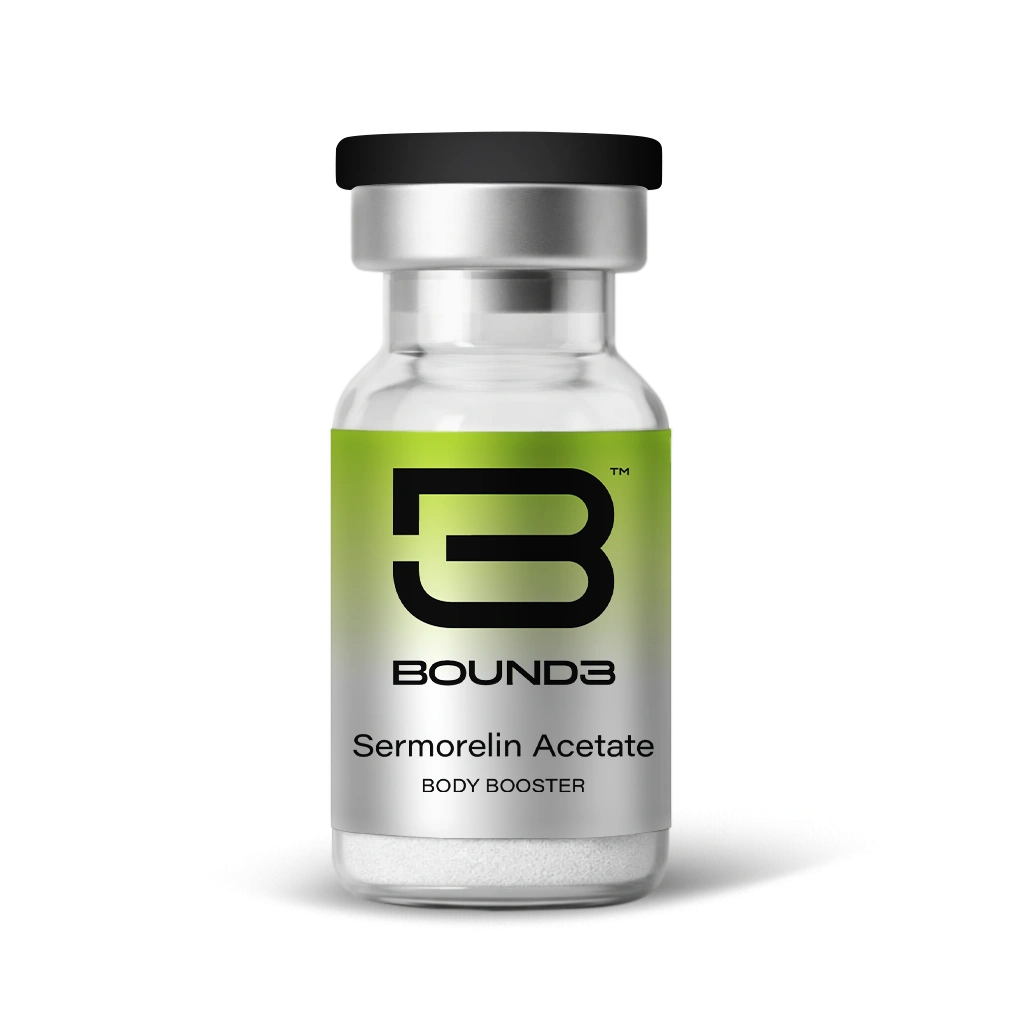
Sermorelin Acetate
Put simply, sermorelin is a peptide used in research to help scientists study how the body naturally triggers growth hormone release. Instead of supplying GH from the outside, it sends a signal to the pituitary to produce GH on its own. That is why it is mainly studied in relation to growth, recovery, body composition, and the function of the hormonal axis.
Product Details
| Parameter | Specification |
| Purity | ≥ 99% (HPLC, third-party tested) |
| Form | Lyophilized peptide powder |
| Content | 5 mg Sermorelin per vial |
| Packaging | Glass vial with sterile closure |
| Storage Conditions | Store lyophilized at 2–8 °C in a dry, desiccated place, protected from light |
| Molecular Formula | C149H246N44O42S |
| Molecular Weight | ≈ 3357.9 g·mol⁻¹ |
| Amino Acid Sequence | H-Tyr-Ala-Asp-Ala-Ile-Phe-Thr-Asn-Ser-Tyr-Arg-Lys-Val-Leu-Gly-Gln-Leu-Ser-Ala-Arg-Lys-Leu-Leu-Gln-Asp-Ile-Met-Ser-NH2 (GHRH(1–29)NH2) |
| CAS Number | 86168-78-7 (acetate) |
| Solubility | Bacteriostatic water |
Overview
Sermorelin Acetate is a synthetic peptide analog of growth hormone-releasing hormone (GHRH), specifically the fragment GHRH(1–29)-NH₂, which is regarded as the shortest synthetic segment of GHRH retaining full biological activity. Pharmacologically, it does not function as growth hormone itself, but rather as a growth hormone secretagogue, meaning that it stimulates the pituitary to release endogenous GH. In the scientific literature, sermorelin is described as a relatively specific stimulator of anterior pituitary somatotroph cells through activation of the GHRH receptor (PubMed).
What it is and how it works
After binding to the GHRH receptor (GHRH-R) on somatotroph cells in the anterior pituitary, sermorelin activates intracellular signaling pathways—primarily the adenylate cyclase/cAMP/PKA system—which results in increased synthesis and secretion of growth hormone. Beyond acute GH release, GHRH is physiologically involved in the proliferation and maintenance of somatotroph function, which is why sermorelin is more accurately described as a physiologic stimulator of the GH axis rather than a replacement for GH itself. This mechanism differs fundamentally from exogenous recombinant GH administration because it preserves hypothalamic–pituitary regulatory control (PubMed). Sermorelin therefore belongs to the class of agents that enhance pulsatile GH release through an upstream physiologic mechanism. Its effect depends on preserved pituitary function; if somatotroph cells are significantly impaired, the response may be attenuated. This explains why GHRH analogs have been investigated not only therapeutically but also as diagnostic tools for assessing GH reserve. Early studies showed that GHRH(1–29)-NH₂ could be useful in testing GH secretion and differentiating certain forms of GH deficiency (PubMed).
Effects confirmed by research
The best-documented effect of sermorelin is stimulation of growth hormone secretion. Review articles and clinical studies report that both intravenous and subcutaneous administration of sermorelin rapidly increase GH levels, which is why it has been used in both diagnostic and research settings related to GH deficiency. Clinical reviews note that the hormonal response to sermorelin is relatively specific and serves as a functional test of somatotropic axis integrity (PubMed). In pediatric research, sermorelin—or more precisely GHRH(1–29)-NH₂—has been studied in children with growth hormone deficiency and idiopathic short stature. Several studies demonstrated increased growth velocity and transient or modest increases in IGF-1, particularly in patients with better preserved pituitary reserve. Importantly, outcomes were not uniform across all patients; better responses were generally observed in those with hypothalamic causes of deficiency rather than severe pituitary damage. This is a critical scientific distinction: sermorelin does not bypass the pituitary, but instead relies on preserved pituitary responsiveness (PubMed). In studies involving older men and women, repeated administration of GHRH(1–29)-NH₂ increased 24-hour GH secretion and raised IGF-1 concentrations, with some reports also noting changes in body composition such as increased lean body mass, altered skin thickness, or selected functional benefits. These findings must be interpreted cautiously: they are research observations in specific populations rather than universal clinical outcomes. Scientifically, the most accurate statement is that sermorelin activates the somatotropic axis and, under certain conditions, may improve biomarkers of anabolic signaling (PubMed).
Professional scientific description
From a scientific standpoint, Sermorelin Acetate is a short-acting GHRH analog that selectively stimulates endogenous growth hormone release through the GHRH receptor. Its principal research-supported effect is activation of the GH/IGF-1 axis, with the magnitude of response depending on preserved pituitary function. Unlike less selective GH secretagogues, it does not primarily act through the ghrelin receptor, but rather through the physiologic hypothalamic–pituitary GHRH pathway. It is therefore most accurately described as a physiologic stimulator of the somatotropic axis with both diagnostic and research relevance (PubMed). For scientific or product-oriented educational content, the three most accurate pillars are: stimulation of endogenous GH secretion through the GHRH receptor, activation of the GH/IGF-1 axis in the presence of preserved pituitary function, utility in research and diagnostic assessment of GH reserve and somatotropic regulation (PubMed).
References
Prakash, A., Goa, K. L. Sermorelin: a review of its use in the diagnosis and treatment of children with idiopathic growth hormone deficiency. Paediatric Drugs. 1999. Mayo, K. E., et al. Regulation of the pituitary somatotroph cell by GHRH and its receptor. Recent Progress in Hormone Research. 2000. Ross, R. J., et al. Treatment of growth-hormone deficiency with growth hormone-releasing hormone (1–29) NH₂. The Lancet. 1987. Chen, R. G., et al. GHRH(1–29)-NH₂ for stimulation of growth in children with GH deficiency. 1993. Kirk, J. M., et al. Treatment with GHRH(1–29)NH₂ in children with idiopathic short stature. 1994. Neyzi, O., et al. GHRH(1–29)-NH₂ compared with growth hormone in GH deficiency. 1993. Corpas, E., et al. Growth hormone-releasing hormone-(1–29) twice daily reverses decreased GH and IGF-1 levels in old men. Journal of Clinical Endocrinology & Metabolism. 1992. Khorram, O., et al. Nightly GHRH(1–29)NH₂ in age-advanced men and women. 1997. Vitiello, M. V., et al. Treating age-related changes in somatotrophic hormones with GHRH analog administration. 2001. Grossman, A., et al. Responses to analogues of growth hormone-releasing hormone in normal subjects and patients with GH deficiency. 1984.