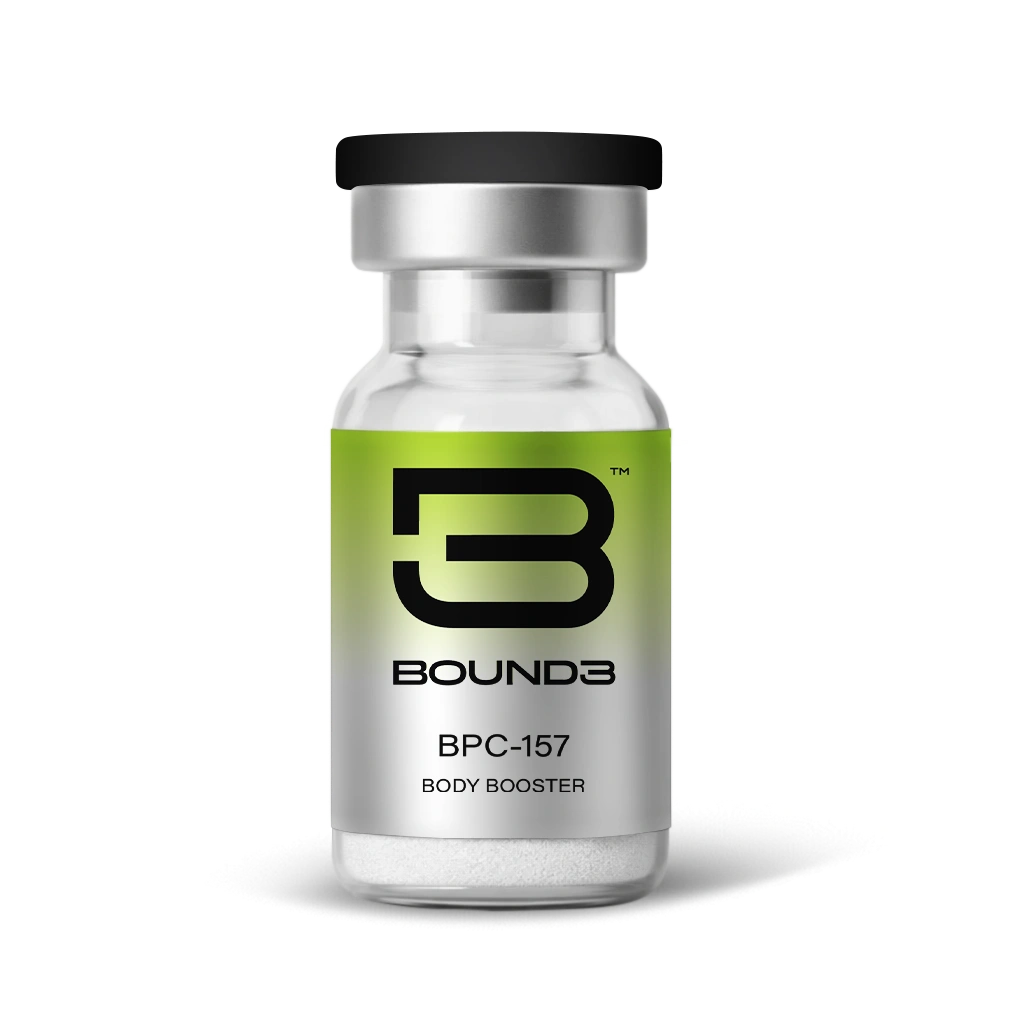
BPC-157
Put simply, BPC-157 is a peptide studied for how the body heals and repairs itself. It is mainly researched for its potential role in: healing muscles, tendons, and ligaments, protecting the stomach and gut, supporting blood vessel formation. It is not a hormone, but rather a compound that may help the body repair damaged tissues.
Product Details
| Parameter | Specification |
| Purity | ≥ 99% (HPLC, third-party tested) |
| Form | Lyophilized peptide powder |
| Content | 10 mg BPC-157 per vial |
| Packaging | Glass vial with sterile closure |
| Storage Conditions | 2–8 °C (lyophilized); protect from light; keep desiccated |
| Molecular Formula | C₆₂H₉₈N₁₆O₂₂ |
| Molecular Weight | ≈ 1419.5 g·mol⁻¹ |
| Amino Acid Sequence | Gly-Glu-Pro-Pro-Pro-Gly-Lys-Pro-Ala-Asp-Asp-Ala-Gly-Leu-Val |
| CAS Number | 137525-51-0 |
| Solubility | Bacteriostatic water |
Overview
BPC-157 (Body Protection Compound-157) is a synthetic peptide derived from a naturally occurring protein fragment found in gastric juice. It consists of a 15-amino-acid sequence and has been extensively studied in preclinical research, particularly in the fields of tissue regeneration, angiogenesis, and gastrointestinal protection. From a scientific standpoint, BPC-157 is considered a pleiotropic peptide, meaning it exerts multiple biological effects across different systems rather than acting through a single receptor or pathway.
What it is and how it works
Unlike classical peptide hormones, BPC-157 does not act through one clearly defined receptor. Current research suggests it influences multiple systems, including: modulation of the nitric oxide (NO) system, regulation of VEGF-mediated angiogenesis, interaction with dopaminergic and serotonergic pathways, stimulation of fibroblast activity and extracellular matrix repair. Experimental studies indicate that BPC-157 promotes tissue healing by enhancing angiogenesis and stabilizing cellular environments within damaged tissues. It also appears to exert protective effects on the vascular endothelium (Vukojević et al., 2007; Sikiric et al., 2018).
Effects confirmed by research
1. Muscle, tendon, and ligament healing
- One of the most studied areas is its effect on the musculoskeletal system, where preclinical studies have demonstrated: accelerated healing of tendons and ligaments, improved tendon-to-bone healing, increased collagen synthesis. These effects are linked to fibroblast activation and growth factor expression (Medvidovic-Grubisic et al., 1997; Sikiric et al., 2010).
2. Gastrointestinal protection
- BPC-157 was originally investigated as a gastroprotective agent. Research shows: protection of gastric mucosa, accelerated healing of ulcers, anti-inflammatory effects in the GI tract. These findings were observed in models involving NSAIDs, alcohol, and stress-induced damage (Sikiric et al., 1993; Veljaca et al., 1995).
3. Angiogenesis and vascular protection
- BPC-157 promotes vascular repair and formation of new blood vessels: increased VEGF expression, improved blood flow in damaged tissues, endothelial protection. This is a critical mechanism for tissue regeneration (Vukojević et al., 2007).
4. Neuroprotective and neuromodulatory effects
- Some studies suggest involvement in: dopamine regulation, serotonin pathways, stress-response modulation. Experimental models have shown neuroprotective effects and behavioral stabilization (Sikiric et al., 2018).
Broader biological context
Unlike GH-related peptides, BPC-157 does not act through a single endocrine axis. Instead, it is a multi-system regulatory peptide affecting: tissue repair, inflammation, vascular stability, cellular signaling. Scientifically, it is best described as a cytoprotective and regenerative peptide.
Professional scientific description
From a scientific perspective, BPC-157 is a stable synthetic peptide derived from a gastric protein fragment that demonstrates: angiogenic activity (VEGF modulation), tissue regenerative effects, gastrointestinal and endothelial protection, interaction with NO pathways and neurotransmitter systems. Its research significance lies in the study of tissue regeneration, vascular biology, and cytoprotection.
References
Sikiric, P., et al. Stable gastric pentadecapeptide BPC 157: review of the pleiotropic beneficial effects. Journal of Physiology Paris. 2018. Vukojević, J., et al. BPC-157 and angiogenesis. Journal of Molecular Medicine. 2007. Medvidovic-Grubisic, M., et al. Tendon healing with BPC-157. Journal of Orthopaedic Research. 1997. Sikiric, P., et al. Gastroprotective effects of BPC-157. Digestive Diseases and Sciences. 1993. Veljaca, M., et al. Ulcer healing effects of BPC-157. European Journal of Pharmacology. 1995. Sikiric, P., et al. BPC-157 in CNS and neurotransmitter systems. Current Neuropharmacology. 2018.