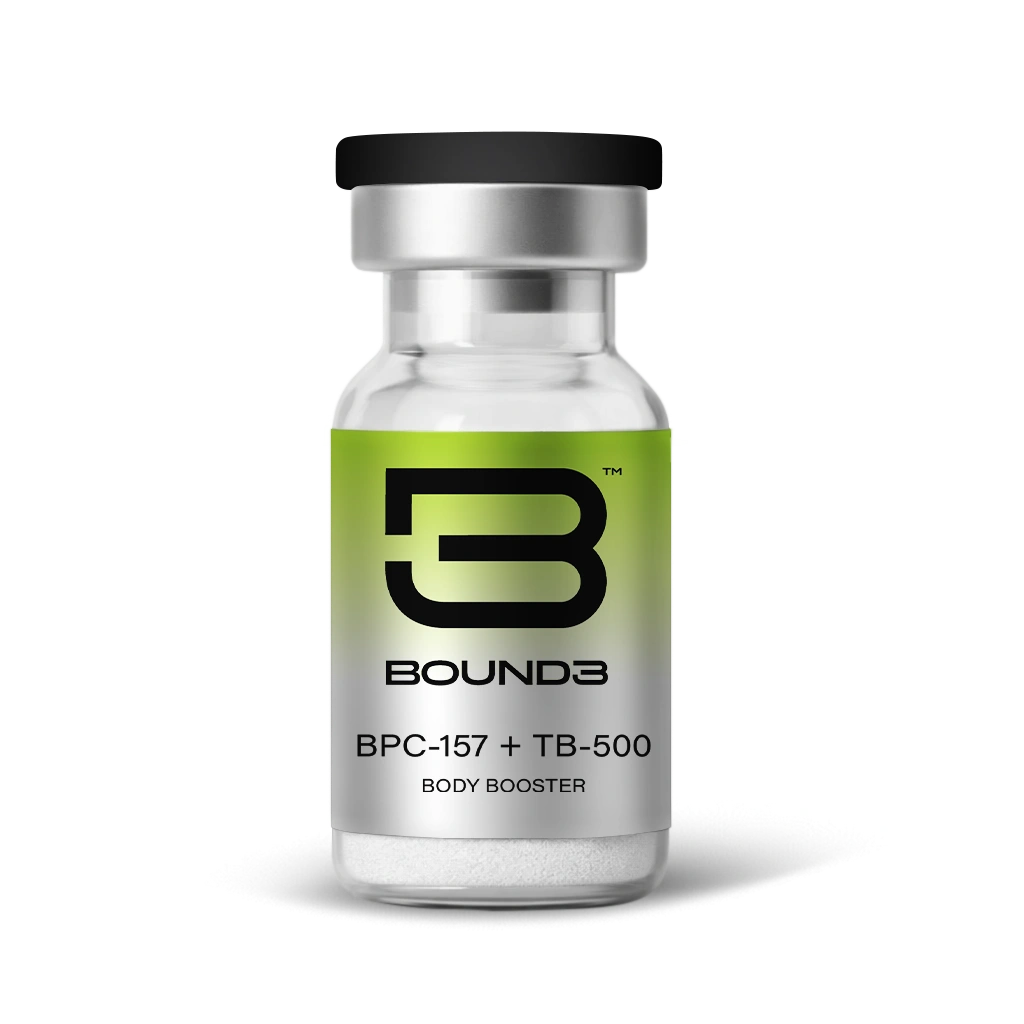
BPC-157 + TB-500
In simple terms, this combination helps researchers understand how the body: repairs injuries, builds new blood vessels, regenerates tissues. One peptide prepares the environment, the other brings the cells that repair damage.
Product Details
| Parameter | Specification |
| Purity | ≥ 99% (HPLC, third-party tested) |
| Form | Lyophilized peptide powder |
| Content | 5 mg BPC-157 & 5 mg TB-500 per vial (10 mg total) |
| Packaging | Glass vial with sterile closure |
| Storage Conditions | Store lyophilized at 2–8 °C (desiccated, protect from light) |
| Molecular Formula | Mixture (BPC-157 & TB-500) |
| Molecular Weight | Mixture |
| Amino Acid Sequences | BPC-157: G-E-P-P-P-G-K-P-A-D-D-A-G-L-V TB-500: Ac-L-K-K-T-E-T-Q |
| CAS Numbers | 137525-51-0 (BPC-157); 885340-08-9 (TB-500) |
| Solubility | Bacteriostatic water |
Overview
The combination BPC-157 + TB-500 represents a pairing of two peptides extensively studied in the context of tissue repair, angiogenesis, and cellular migration. BPC-157 is a synthetic peptide derived from gastric protein fragments with cytoprotective properties. TB-500 is a synthetic fragment of Thymosin Beta-4, a protein involved in cellular migration and cytoskeletal organization. From a scientific perspective, this combination targets complementary regenerative mechanisms: BPC-157 – tissue stabilization and vascular protection, TB-500 – cellular migration and systemic repair.
What it is and how it works
BPC-157 mechanism: BPC-157 is believed to act via: modulation of the nitric oxide system, VEGF signaling and angiogenesis, endothelial protection, extracellular matrix and inflammatory modulation (Sikiric et al., 2018).
TB-500 mechanism: TB-500 acts through: binding to G-actin → cytoskeletal regulation, stimulation of cell migration, promotion of angiogenesis and differentiation, reduction of inflammation (Goldstein et al., 2005; Malinda et al., 1999).
Synergistic mechanism
Scientifically, the combination is understood as: local stabilization + systemic regeneration. BPC-157 improves the tissue environment, and TB-500 enhances cell movement and repair processes. This may result in: faster healing, improved vascularization, more efficient tissue remodeling.
Effects confirmed by research
1. Muscle, tendon, and ligament repair
- BPC-157: enhances tendon and ligament healing, increases collagen synthesis. TB-500: promotes cell migration, supports muscle regeneration.
2. Angiogenesis and vascular repair
- Both peptides support angiogenesis via different pathways: BPC-157 → VEGF and NO modulation, TB-500 → endothelial migration.
3. Anti-inflammatory and cytoprotective effects
- BPC-157 → stabilizes inflammation and tissue damage. TB-500 → reduces local inflammation and fibrosis.
4. Soft tissue and wound healing
- TB-500: accelerates wound healing, enhances epithelialization. BPC-157: improves blood supply and tissue stability.
Scientific description
From a scientific standpoint, BPC-157 + TB-500 represents a: cytoprotective and regenerative peptide system combining: NO/VEGF modulation, cytoskeletal and cellular migration control.
References
Sikiric, P., et al. BPC 157: pleiotropic effects. Journal of Physiology Paris. 2018. Vukojević, J., et al. BPC-157 and angiogenesis. Journal of Molecular Medicine. 2007. Medvidovic-Grubisic, M., et al. Tendon healing with BPC-157. Journal of Orthopaedic Research. 1997. Goldstein, A. L., Kleinman, H. K. Thymosin beta-4: repair and regeneration. Annals of the New York Academy of Sciences. 2005. Malinda, K. M., et al. Thymosin beta-4 induces angiogenesis. FASEB Journal. 1999. Sosne, G., Kleinman, H. K. Thymosin beta-4 and wound healing. Wound Repair and Regeneration. 2009.