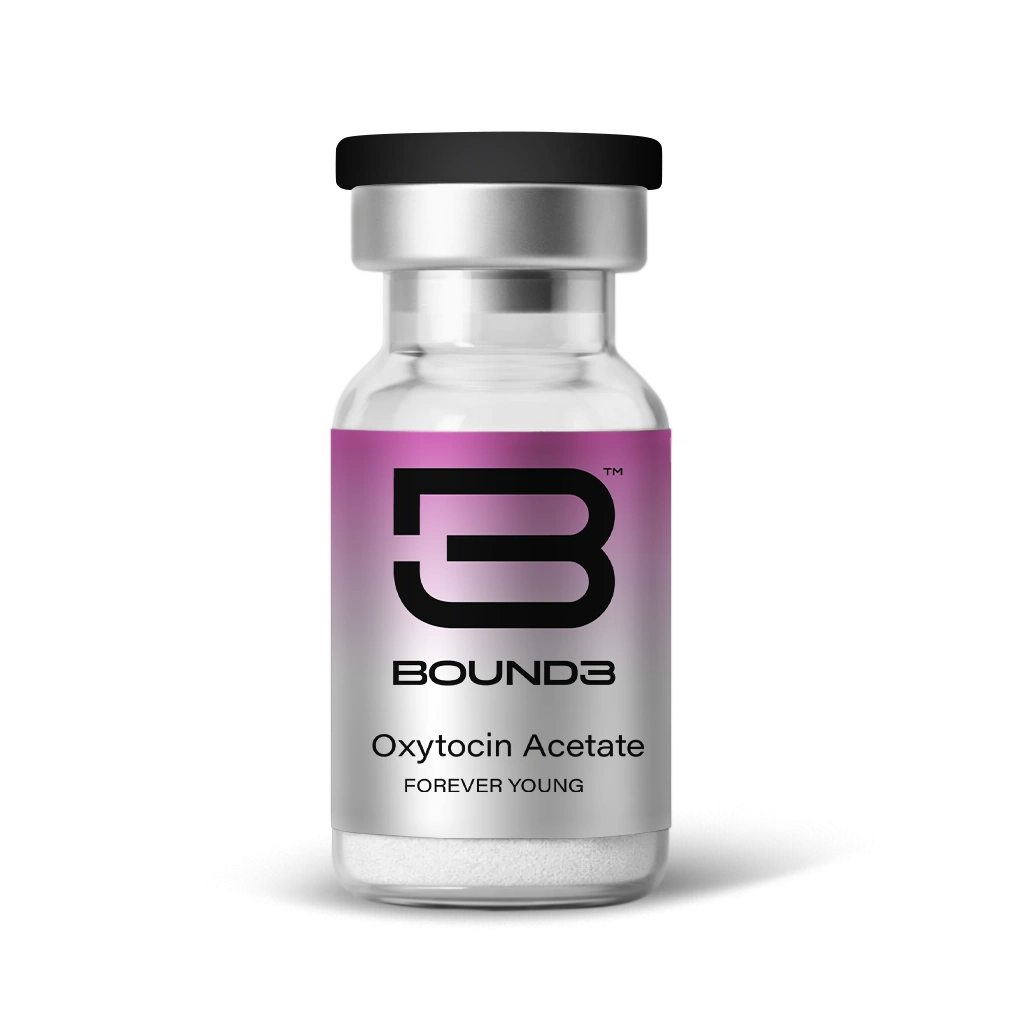
Oxytocin Acetate
In simple terms, oxytocin is often called the bonding hormone. It is studied for how it affects: emotions and relationships, stress and relaxation, social behavior.
Product Details
| Parameter | Specification |
| Purity | ≥ 99% (HPLC, third-party tested) |
| Form | Lyophilized peptide powder |
| Content | 2 mg Oxytocin acetate per vial |
| Packaging | Glass vial with sterile closure |
| Storage Conditions | Store lyophilized at 2–8 °C (desiccated, protect from light) |
| Molecular Formula | C43H66N12O12S2 |
| Molecular Weight | ≈ 1007.2 g·mol⁻¹ |
| Amino Acid Sequence | Cys-Tyr-Ile-Gln-Asn-Cys-Pro-Leu-Gly-NH2 (disulfide bridge) |
| CAS Number | 50-56-6 |
| Solubility | Bacteriostatic water |
Overview
Oxytocin Acetate is a synthetic form of the naturally occurring neuropeptide oxytocin, produced in the hypothalamus and released from the posterior pituitary. It is a nonapeptide (9 amino acids) that plays a central role in neuroendocrine regulation, social behavior, reproduction, and stress response. Oxytocin functions as both: a hormone (peripheral effects), a neurotransmitter / neuromodulator (central effects). Its actions are mediated through the oxytocin receptor (OXTR), a G-protein coupled receptor (Lee et al., 2009).
What it is and how it works
Oxytocin binds to OXTR receptors located in: brain regions (amygdala, hypothalamus), uterus, mammary glands, cardiovascular tissues. Receptor activation leads to: increased intracellular Ca²⁺, activation of PLC signaling, downstream muscular or neural effects. In the brain, oxytocin modulates: social behavior, emotional regulation, stress responses via the HPA axis (Neumann & Landgraf, 2012).
Effects confirmed by research
1. Social bonding and behavior
- Oxytocin is strongly associated with: social bonding, trust and empathy, parental and pair-bonding behavior (Kosfeld et al., 2005).
2. Stress and anxiety regulation
- reduces cortisol levels, modulates HPA axis, promotes relaxation (Heinrichs et al., 2003).
3. Neurobiological effects
- modulates amygdala activity, influences fear and emotional processing, improves social cognition (Meyer-Lindenberg et al., 2011).
4. Reproductive functions
- uterine contraction, milk ejection, reproductive physiology (Gimpl & Fahrenholz, 2001).
5. Metabolic and cardiovascular roles
- Emerging research suggests: effects on metabolism, appetite regulation, cardiovascular function (Lawson, 2017).
Scientific description
From a scientific standpoint, Oxytocin Acetate is: a synthetic analog of endogenous oxytocin, an agonist of OXTR receptors, a regulator of: social behavior, stress response, neuroendocrine integration.
References
Lee, H. J., et al. Oxytocin: the great facilitator of life. Progress in Neurobiology. 2009. Neumann, I. D., Landgraf, R. Oxytocin and vasopressin systems. Trends in Neurosciences. 2012. Kosfeld, M., et al. Oxytocin increases trust. Nature. 2005. Heinrichs, M., et al. Oxytocin and cortisol suppression. Biological Psychiatry. 2003. Meyer-Lindenberg, A., et al. Oxytocin and social cognition. Nature Reviews Neuroscience. 2011. Gimpl, G., Fahrenholz, F. Oxytocin receptor system. Physiological Reviews. 2001. Lawson, E. A. Oxytocin and metabolism. Endocrine Reviews. 2017.