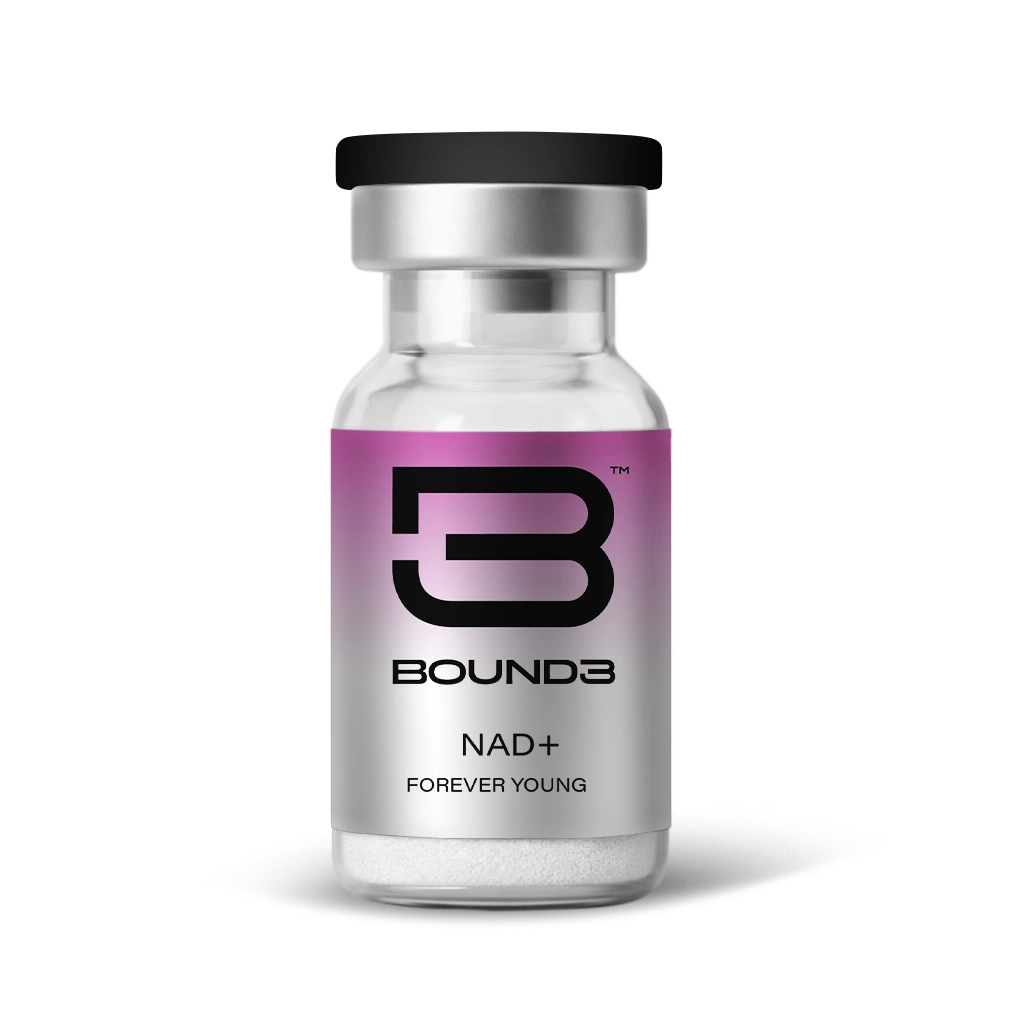
NAD+
In simple terms, NAD⁺ is a molecule every cell needs to produce energy and repair itself. It is often studied as a key factor in: energy, recovery, aging.
Product Details
| Parameter | Specification |
| Purity | High purity; third-party tested (COA/HPLC) |
| Form | Lyophilized powder |
| Content | 500 mg NAD+ per vial |
| Packaging | Glass vial with sterile closure |
| Storage Conditions | 2–8 °C, protect from light; keep desiccated |
| Molecular Formula | C21H27N7O14P2 |
| Molecular Weight | 663.43 g·mol⁻¹ |
| IUPAC Name | β-nicotinamide adenine dinucleotide (oxidized form) |
| CAS Number | 53-84-9 |
| Solubility | Bacteriostatic water |
Overview
NAD⁺ (Nicotinamide Adenine Dinucleotide) is an essential coenzyme found in all living cells, playing a central role in metabolism, energy production, and cellular regulation. Unlike peptides, NAD⁺ is a pyridine nucleotide that functions as a key electron carrier in redox reactions. It is considered one of the most critical molecules in biology due to its involvement in: mitochondrial function, ATP production, DNA repair, aging and longevity pathways (Chini et al., 2017; Covarrubias et al., 2021).
What it is and how it works
NAD⁺ functions as a redox cofactor, cycling between NAD⁺ and NADH forms. This process is essential for: glycolysis, the Krebs cycle, oxidative phosphorylation. Without NAD⁺, efficient cellular energy production is not possible. Additionally, NAD⁺ serves as a substrate for key enzymes: sirtuins (SIRT1–SIRT7), PARPs (DNA repair enzymes), CD38 (immune regulation). These pathways link NAD⁺ directly to: epigenetics, longevity, cellular stress responses (Imai & Guarente, 2014).
Effects confirmed by research
1. Energy metabolism and mitochondrial function
- NAD⁺ is essential for mitochondrial activity. Research shows that increasing NAD⁺: enhances oxidative metabolism, promotes mitochondrial biogenesis, increases ATP production (Cantó et al., 2015).
2. Aging and longevity
- NAD⁺ is strongly linked to aging biology: activates sirtuins (SIRT1), improves metabolic flexibility, protects against cellular stress (Yoshino et al., 2018).
3. DNA repair
- NAD⁺ is required for PARP enzymes that: repair DNA damage, maintain genomic stability (Chini et al., 2017).
4. Metabolic health
- Research suggests NAD⁺ influences: insulin sensitivity, lipid metabolism, inflammation (Yoshino et al., 2011).
5. Neuroprotection
- NAD⁺ plays a role in: neuronal survival, brain energy metabolism, neurodegenerative protection (Covarrubias et al., 2021).
Scientific description
From a scientific standpoint, NAD⁺ is: a central redox coenzyme, regulator of mitochondrial bioenergetics, substrate for sirtuins and PARPs.
References
Imai, S., Guarente, L. NAD+ and sirtuins in aging and disease. Trends in Cell Biology. 2014. Chini, E. N., et al. The NAD metabolome in aging and disease. Nature Reviews Endocrinology. 2017. Covarrubias, A. J., et al. NAD+ metabolism and its roles in cellular processes. Nature Reviews Molecular Cell Biology. 2021. Cantó, C., et al. NAD+ metabolism and mitochondrial function. Cell Metabolism. 2015. Yoshino, J., et al. NAD+ intermediates and metabolic health. Cell Metabolism. 2011. Yoshino, J., et al. NAD+ boosting in humans. Science. 2018.