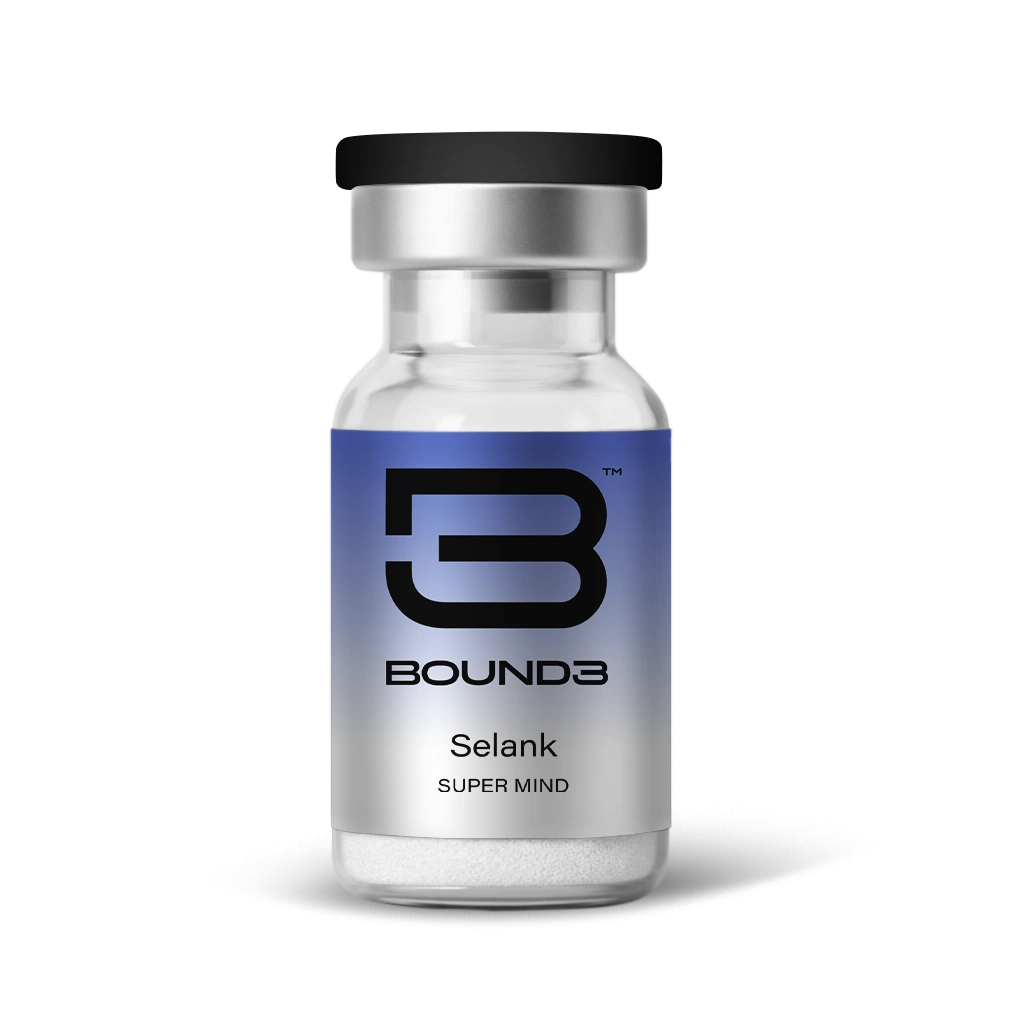
Selank
In simple terms, Selank helps the brain: reduce anxiety, improve focus, stay calm without sedation.
Product Details
| Parameter | Specification |
| Purity | ≥ 99% (HPLC, third-party tested) |
| Form | Lyophilized peptide powder |
| Content | 10 mg Selank per vial |
| Appearance | White to off-white powder |
| Packaging | Glass vial with sterile closure |
| Storage Conditions | 2–8 °C (lyophilized), protect from light, keep desiccated |
| Molecular Formula | C33H57N11O9 |
| Molecular Weight | ≈ 751.9 g·mol⁻¹ |
| Amino Acid Sequence | Thr–Lys–Pro–Arg–Pro–Gly–Pro (7 aa) |
| CAS Number | 129954-34-3 |
| Solubility | Bacteriostatic water |
Overview
Selank is a synthetic neuropeptide derived from the endogenous immune peptide tuftsin. It is a modified heptapeptide with the sequence: Thr-Lys-Pro-Arg-Pro-Gly-Pro. It is classified as: a neuropeptide regulator, an anxiolytic and cognitive modulator, a link between the immune and nervous systems (Kozlovskii et al., 2003).
What it is and how it works
Selank acts in the CNS as a neuromodulator, influencing: GABAergic system, serotonergic system, dopaminergic pathways. It modulates: GABA receptor activity, serotonin metabolism, neurotrophic signaling. Unlike benzodiazepines: minimal sedation, low dependence potential (Kost et al., 2015).
Effects confirmed by research
1. Anxiolytic effects
- reduced anxiety, emotional stabilization (Kozlovskii et al., 2003).
2. Cognitive enhancement
- improved memory, better learning (Zozulya et al., 2008).
3. Stress modulation
- reduced stress response, serotonin regulation (Kost et al., 2015).
4. Neuroimmune effects
- cytokine modulation, immune system interaction (Ashmarin et al., 2005).
5. Neuroprotection
- neuronal protection, improved neuroplasticity.
Scientific description
Selank is: a tuftsin-derived peptide, regulator of: GABA signaling, serotonin pathways, neuroimmune interactions.
References
Kozlovskii, I. I., et al. Selank anxiolytic effects. 2003. Kost, N. V., et al. Neurotransmitter modulation. 2015. Zozulya, A. A., et al. Cognitive effects. 2008. Ashmarin, I. P., et al. Neuropeptides and immunity. 2005.